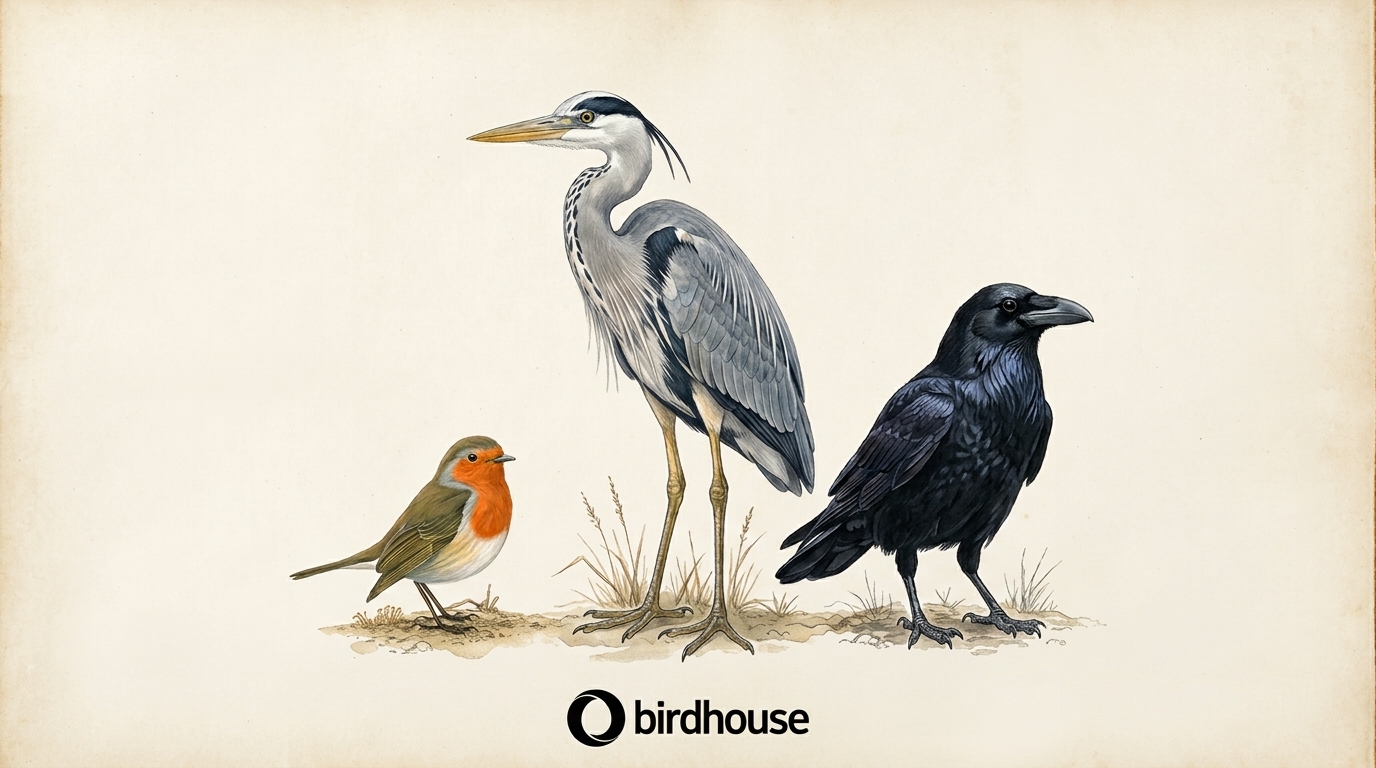
Robin, Heron and Raven: How Our Models Hold Against Tech Giants
October 14, 2026
You don't need a rocket to cross the street
The AI conversation tends to go one way: whoever has the largest model wins. OpenAI, Anthropic and Google DeepMind are building remarkable frontier systems, and we use them. But when we looked at what our agents do all day, most of it was nowhere near the frontier.
A lot of it is routing a ticket, pulling a date out of a PDF, reviewing a diff, or summarising a thread. You don't need the biggest model ever trained for any of that. You need something fast, cheap and reliable, and you need it thousands of times an hour.
So we built our own family of models: Robin, Heron and Raven. Each one is sized for a particular kind of job.
Meet the flock
Robin (v0.7), our smallest model. It handles the high-volume, low-latency decisions that fill most of an agent's day: classification, routing and extraction from documents. It's small enough to run close to your data, even on the edge, and cheap enough to call on every event.
Heron (v0.6), our general execution model. This is the everyday workhorse. It writes and reviews code, drafts and summarises, and carries a structured task through several steps without the bill that comes with the largest models.
Raven (v0.6), our smartest model. Raven gets the hard problems: complex code, hunting down subtle security vulnerabilities, and multi-step reasoning where being right matters more than being quick.
Where the giants win, and how we challange them
Let's be straight: on broad, open-ended reasoning, the flagship models from the big labs are extraordinary, and we're not yet beaten them on general intelligence. A frontier model is a generalist trained to do everything well. Our models are trained to execute, and that's a narrower target, which is a big part of why they can hit it.
Agent work is mostly execution. When the task is well scoped, a focused model can match a much larger one on quality and beat it easily on the things that pile up at scale:
Cost per task. A small model called a million times costs a fraction of a frontier model called a million times.
Latency. Robin answers before a large model has finished warming up, and that matters when an agent makes dozens of calls in a chain.
Privacy and control. Smaller models can run close to your data, so sensitive documents don't have to leave your environment.
Predictability. We trained them, so we know how they behave and can tune them for the workflows we actually run.
The numbers we're willing to stand behind
In our evaluation, our general model Heron scores 87.0 on coding (measured against SWE-bench) and 89.1 on task execution. These are extraordinary results for an AI company with less then 30 employees.
The question isn't which model is biggest. It's which model is the smallest one that can do the job well.
How they work together
The models run inside Birdhouse OS, which sends each task to the lightest model that can handle it and only moves up the family when the work requires it:
Robin takes the first pass: sorting, routing, extracting.
Heron picks up most of the real work: code, drafts, multi-step tasks.
Raven steps in when something is genuinely hard.
A third-party frontier model is the last resort, not the default.
That last step matters. We're not anti-frontier. We just think reaching for the biggest model on every call is a habit, not a strategy, and it's an expensive one.
What this means for teams building with AI
If every request in your stack goes to the largest model available, you're probably paying for capability you aren't using. The teams that get the most out of AI right-size their models: small and fast where the work is routine, heavyweight where it counts, and humans supervising the parts that need judgement.
That's how we deliver at Birdhouse. Agents do the work, the right model handles each step, and our people focus on direction and quality. If you want to see Robin, Heron and Raven on your own workload, take a look at the models and get in touch.